
August 28, 2026
If you walk into almost any hospital across Europe today, you will find a system pushed past its limits. Staffing shortages are severe, up to 60% of operating budgets are swallowed up by personnel costs, and three out of four facilities are running at a loss.
For years, the answer to healthcare bottlenecks was to build more administrative software, tools designed to optimize existing desk-bound workflows. But you can’t software-optimize your way out of a shortage of physical hands. To keep European healthcare standing, we need to automate the physical world.
This isn’t just a distant vision anymore. With programs like Horizon Europe committing €180 million to breakthrough tech and robotics, artificial intelligence is finally moving out of the cloud and straight into the clinic. AI-driven robotics are rapidly shifting from a sci-fi luxury into an everyday necessity.
Historically, medical robotics meant massive, hyper-specialized, multi-million-dollar machines. They were incredible engineering feats, but they were rigid, hard to integrate, and nearly impossible to scale across different environments.
Today, the entire ecosystem is turning on its head. Hardware components are commoditizing, and software is taking center stage. Modern AI models act as the central brain, turning off-the-shelf hardware into adaptable, intelligent fleets capable of navigating unpredictable clinical environments.
Instead of forcing hospitals to redesign their rooms around rigid machines, modern physical AI adapts to existing clinical workflows. This shift isn't just happening in medicine, we are seeing cross-industry momentum everywhere. Look at logistics and defense, where companies like Sereact (who recently raised a Series B led by Headline) are using Vision Language Action Models to automate complex pick-and-place physical tasks.
Europe is quietly becoming a powerhouse for this shift. Engineering hubs in cities like Munich and Zurich are pooling deep talent, research labs, and capital to build the foundation for physical AI on a global scale.
While administrative support is important, the real magic happens in direct clinical care. By letting intelligent automation handle repetitive physical procedures, we can expand patient access while giving doctors their time back.
Look at our portfolio company, SquareMind, who recently announced an $18M Series A led by Sonder Capital. They are completely transforming dermatology with their Swan™ robot, the world’s first system that captures standardized, full-body dermoscopic imaging in just minutes.
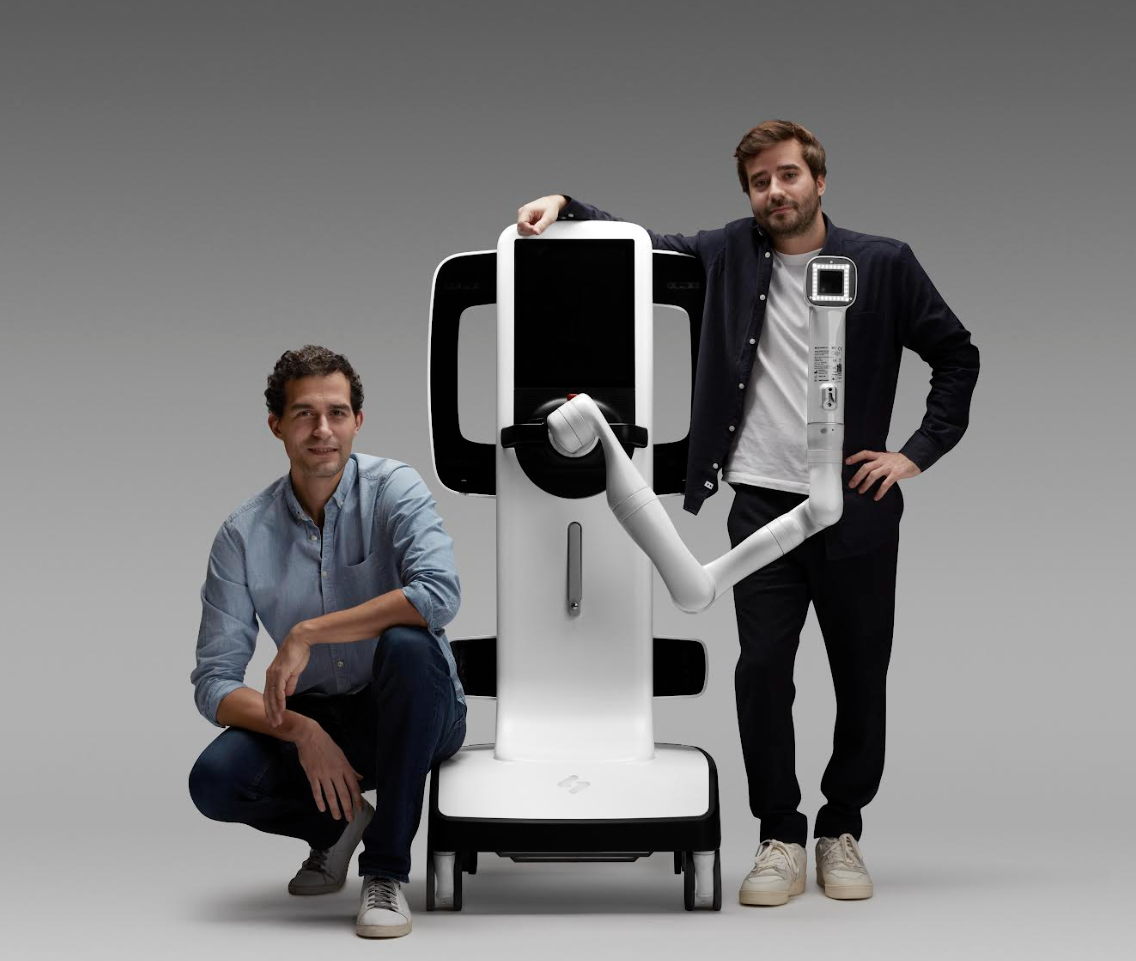
Instead of a dermatologist spending tedious, exhausting hours manually capturing high-resolution photos of every square inch of skin, the robot handles the mechanical setup. The physician gets clear, precise data without the burnout, leaving them free to focus on what matters most: diagnosis, judgment, and genuine patient connection.
If you’re building at the intersection of AI and the physical world, a few key patterns are emerging:
The transition from cloud software to clinical physical AI is healthcare’s most exciting frontier. If you are a founder engineering the next generation of physical automation, we’d love to talk! Reach out to us here and join the Calm/Storm community.
